
Keywords
nerve block
peripheral nerves
postoperative pain
ultrasonography
Categories
How to Cite
Abstract
The supraclavicular brachial plexus block remains a reliable and time-efficient technique for surgical anaesthesia and postoperative analgesia for upper limb procedures. Ultrasound guidance has improved visualisation of the plexus,
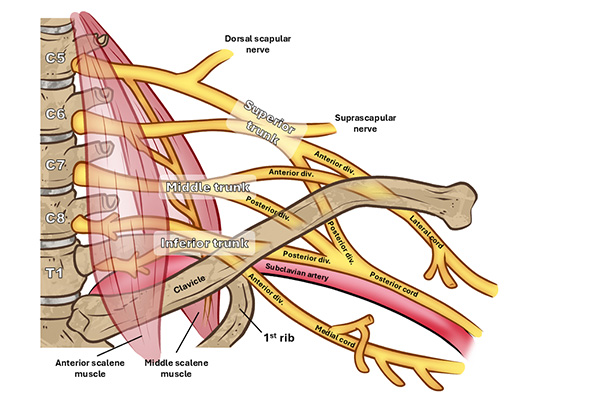
subclavian vessels, first rib and pleura, but clinically important risks persist, including pneumothorax, vascular puncture, local anaesthetic systemic toxicity, nerve injury and hemidiaphragmatic paresis. Contemporary practice has moved beyond the traditional cluster injection toward more anatomy-directed strategies. Corner pocket and intertruncal approaches aim to improve coverage of the inferior trunk and the ulnar nerve, while selective trunk and superior trunk blocks allow more tailored sensory profiles for whole-limb or shoulder-focused indications. Continuous supraclavicular catheter techniques, including proximal longitudinal oblique approaches, may expand the role of supraclavicular blockade in shoulder analgesia while reducing, but not abolishing, diaphragmatic involvement compared with interscalene techniques. This narrative review summarises the relevant anatomy, historical evolution, named variants, clinical efficacy, complications, local anaesthetic strategies, adjuvants, and catheter techniques related to the supraclavicular brachial plexus block. It also proposes a practical decision-making framework to guide technique selection based on surgical site, need for ulnar coverage, anticipated duration of analgesia, pulmonary reserve, coagulation status, and patient-specific risk. Meticulous ultrasound technique, appropriate volume selection, as well as readiness to manage complications remain central to safe and effective practice.
References
Hanumanthaiah D, Vaidiyanathan S, Gartska M, Szucs S, Iohom G. Ultrasound guided supraclavicular block. Med Ultrason. 2013 Sep;15(3):224–9. https://doi.org/10.11152/mu.2013.2066.153.dh1mg2
Perlas A, Lobo G, Lo N, Brull R, Chan VWS, Karkhanis R. Ultrasound-guided supraclavicular block. Reg Anesth Pain Med. 2009 Mar;34(2):171–6. https://doi.org/10.1097/AAP.0b013e31819a3f81
Gauss A, Tugtekin I, Georgieff M, Dinse-Lambracht A, Keipke D, Gorsewski G. Incidence of clinically symptomatic pneumothorax in ultrasound-guided infraclavicular and supraclavicular brachial plexus block. Anaesthesia. 2014 Apr;69(4):327–36. https://doi.org/10.1111/anae.12586 PubMed PMID: 24641639.
Barrington MJ, Kluger R. Ultrasound guidance reduces the risk of local anesthetic systemic toxicity following peripheral nerve blockade. Reg Anesth Pain Med. 2013;38(4):289–97. https://doi.org/10.1097/AAP.0b013e318292669b
Neal JM, Barrington MJ, Brull R, et al. The second ASRA practice advisory on neurologic complications associated with regional anesthesia and pain medicine. Reg Anesth Pain Med. 2015;40(5):401–30. https://doi.org/10.1097/AAP.0000000000000286
Chan VWS, Perlas A, Rawson R, Odukoya O. Ultrasound-guided supraclavicular brachial plexus block. Anesth Analg. Nov;97(5):1514-1517. https://doi.org/10.1213/01.ANE.0000062519.61520.14
Renes SH, Spoormans HH, Gielen MJ, Rettig HC, Van Geffen GJ. Hemidiaphragmatic paresis can be avoided in ultrasound-guided supraclavicular brachial plexus block. Reg Anesth Pain Med. 2009 Nov;34(6):595–9. https://doi.org/10.1097/AAP.0b013e3181bfbd83 PubMed PMID: 19916254.
Petrar SD, Seltenrich ME, Head SJ, Schwarz SKW. Hemidiaphragmatic paralysis following ultrasound- guided supraclavicular versus infraclavicular brachial plexus blockade. Reg Anesth Pain Med. 2015;40(2):133–8. https://doi.org/10.1097/AAP.0000000000000215
Tedore TR, Lin HX, Pryor KO, et al. Dose-response relationship between local anesthetic volume and hemidiaphragmatic paresis following ultrasound-guided supraclavicular brachial plexus blockade. Reg Anesth Pain Med. 2020 Nov 20;45(12):979–84. https://doi.org/10.1136/rapm-2020-101728 PubMed PMID: 33004656.
Jo Y, Park J, Oh C, et al. Comparison of the ulnar nerve blockade between intertruncal and corner pocket approaches for supraclavicular block: a randomized controlled trial. Korean J Anesthesiol. 2021 Dec 1;74(6):522–30. https://doi.org/10.4097/kja.21028 PubMed PMID: 33840177.
Siddiqui U, Perlas A, Chin K, et al. Intertruncal approach to the supraclavicular brachial plexus, current controversies and technical update: A daring discourse. Reg Anesth Pain Med. 2020 May 1;45(5):377–80. https://doi.org/10.1136/rapm-2019-101260 PubMed PMID: 32165552.
Sivakumar RK, Samy W, Pakpirom J, Songthamwat B, Karmakar MK. Ultrasound-guided selective trunk block: Evaluation of ipsilateral sensorimotor block dynamics, hemidiaphragmatic function and efficacy for upper extremity surgery. A single-centre cohort study. Eur J Anaesthesiol. 2022 Oct;39(10):801–9. https://doi.org/10.1097/EJA.0000000000001736
Sinha C, Kumari P, Kumar A, et al. Superior trunk versus interscalene brachial plexus block in humerus surgery: a randomised controlled trial. Anaesthesiol Intensive Ther. 2024 Aug 30;56(3):194–8. https://doi.org/10.5114/ait.2024.142772
Soares L, Brull R, Lai J, Chan VWS. Eight ball, corner pocket: the optimal needle position for ultrasound-guided supraclavicular block. Reg Anesth Pain Med. 2007 Jan;32(1):94–5. https://doi.org/10.1016/j.rapm.2006.10.007
Brull R, Chan VWS. The corner pocket revisited. Reg Anesth Pain Med. 2011 May;36(3):308. https://doi.org/10.1097/AAP.0b013e3182168177
Koh WU, Kim HJ, Park HS, Choi WJ, Yang HS, Ro YJ. A randomised controlled trial comparing continuous supraclavicular and interscalene brachial plexus blockade for open rotator cuff surgery. Anaesthesia. 2016 Jun 8;71(6):692–9. https://doi.org/10.1111/anae.13419
Kim YJ, Kim H, Kim S, et al. A comparison of the continuous supraclavicular brachial plexus block using the proximal longitudinal oblique approach and the interscalene brachial plexus block for arthroscopic shoulder surgery. Eur J Anaesthesiol. 2024 Jun;41(6):402–10. https://doi.org/10.1097/EJA.0000000000001934
Hadzic A. Hadzic’s peripheral nerve blocks and anatomy for ultrasound-guided regional anesthesia. 2nd ed. New York: The McGraw-Hill Companies; 2012.
Karmakar MK, Pakpirom J, Songthamwat B, Areeruk P. High definition ultrasound imaging of the individual elements of the brachial plexus above the clavicle. Reg Anesth Pain Med. 2020 May 1;45(5):344–50. https://doi.org/10.1136/rapm-2019-101089 PubMed PMID: 32102798.
Songthamwat B, Pakpirom J, Pangthipampai P, Vorapaluk P, Karmakar MK. Reliability of a sequential ultrasound imaging technique (SUIT) to identify the individual elements of the brachial plexus above the clavicle. Reg Anesth Pain Med. 2021 Dec 1;46(12):1107–9. https://doi.org/10.1136/rapm-2021-102701 PubMed PMID: 33952686.
Winnie AP, Collins VJ. The subclavian perivascular technique of brachial plexus anesthesia. Anesthesiology. 1964 May 1;25(3):353–63. https://doi.org/10.1097/00000542-196405000-00014
Franco C, Vieira Z. 1,001 subclavian perivascular brachial plexus blocks: Success with a nerve stimulator. Reg Anesth Pain Med. 2000 Jan;25(1):41–6. https://doi.org/10.1016/S1098-7339(00)80009-7
Techasuk W, González AP, Bernucci F, Cupido T, Finlayson RJ, Tran DQ. A randomized comparison between double-injection and targeted intracluster-injection ultrasound-guided supraclavicular brachial plexus block. Anesth Analg. 2014 Jun;118(6):1363–9. https://doi.org/10.1213/ANE.0000000000000224
Wang Z, Guo J, Xie H, et al. Intertruncal versus classical approach to supraclavicular brachial plexus block on sensory-motor blockade for upper extremity surgery: a randomized controlled non-inferiority trial. Korean J Anesthesiol. 2025 Aug 1;78(4):321–30. https://doi.org/10.4097/kja.24526 PubMed PMID: 40740147.
Trivedi S, Gupta S, Bhardwaj H, Sahoo TK, Gupta S, Trivedi G. Efficacy of intertruncal and corner-pocket approaches of ultrasound-guided supraclavicular block in terms of ulnar nerve blockade: A randomised controlled study. Indian J Anaesth. 2023 Sep;67(9):778–84. https://doi.org/10.4103/ija.ija_45_23
Burckett-St.Laurent D, Chan VWS, Chin KJ. Refining the ultrasound-guided interscalene brachial plexus block: the superior trunk approach. Canadian Journal of Anesthesia/Journal canadien d’anesthésie. 2014 Dec 11;61(12):1098–102. https://doi.org/10.1007/s12630-014-0237-3
Kim DH, Lin Y, Beathe JC, Liu J, Oxendine JA, Haskins SC, et al. Superior trunk block. Anesthesiology. 2019 Sep;131(3):521–33. https://doi.org/10.1097/ALN.0000000000002841
Kang R, Jeong JS, Chin KJ. Superior trunk block provides noninferior analgesia compared with interscalene brachial plexus block in arthroscopic shoulder surgery. Anesthesiology. 2019 Dec;131(6):1316–26. https://doi.org/10.1097/ALN.0000000000002919
Amaral S, Arsky Lombardi R, Medeiros H, Nogueira A, Gadsden J. Superior trunk block is an effective phrenic-sparing alternative to interscalene block for shoulder arthroscopy: A Systematic Review and Meta-Analysis. Cureus. 2023 Nov 3. https://doi.org/10.7759/cureus.48217
Henry BM, Graves MJ, Pękala JR, et al. Origin, branching, and communications of the intercostobrachial nerve: a meta-analysis with implications for mastectomy and axillary lymph node dissection in breast cancer. Cureus. 2017 Mar 17. https://doi.org/10.7759/cureus.1101
Samerchua A, Supphapipat K, Leurcharusmee P, Lapisatepun P, Thammasupapong P, Lorsomradee S. Randomized comparison between ultrasound-guided proximal and distal approaches of intercostobrachial nerve block as an adjunct to supraclavicular brachial plexus block for upper arm arteriovenous access procedures. Reg Anesth Pain Med. 2026 Jan;51(1):76–81. https://doi.org/10.1136/rapm-2024-105973
Tran DQH, Russo G, Muñoz L, Zaouter C, Finlayson RJ. A prospective, randomized comparison between ultrasound-guided supraclavicular, infraclavicular, and axillary brachial plexus blocks. Reg Anesth Pain Med. 2009 Jul;34(4):366–71. https://doi.org/10.1097/AAP.0b013e3181ac7d18
Alfred V, Srinivasan G, Zachariah M. Comparison of ultrasound with peripheral nerve stimulator guided technique for supraclavicular block in upper limb surgeries: A randomized controlled trial. Anesth Essays Res. 2018;12(1):50. https://doi.org/10.4103/aer.AER_211_17
Rueda Rojas VP, Meléndez Flórez HJ, Orozco Galvis E. Analysis of previous training with simulated models on the success rate of ultrasound-guided supraclavicular block. Prospective cohort study. Rev Esp Anestesiol Reanim. 2019 May;66(5):241–9. https://doi.org/10.1016/j.redar.2019.01.003
Satapathy AR, Khalid I Bin, Fathil SM. Simulation in regional anaesthesia: a narrative review of its history, evolution and future prospects. J Clin Med. 2024 Dec 26;14(1):67. https://doi.org/10.3390/jcm14010067
Abell DJ, Barrington MJ. Pneumothorax after ultrasound-guided supraclavicular block. Reg Anesth Pain Med. 2014;39(2):164–7. https://doi.org/10.1097/AAP.0000000000000045
Kopp SL, Vandermeulen E, McBane RD, Perlas A, Leffert L, Horlocker T. Regional anesthesia in the patient receiving antithrombotic or thrombolytic therapy: American Society of Regional Anesthesia and Pain Medicine Evidence-Based Guidelines (fifth edition). Reg Anesth Pain Med. 2025 Jan 29;rapm-2024-105766. https://doi.org/10.1136/rapm-2024-105766
Kietaibl S, Ferrandis R, Godier A, Llau J, Lobo C, Macfarlane AJ, et al. Regional anaesthesia in patients on antithrombotic drugs. Eur J Anaesthesiol. 2022 Feb;39(2):100–32. https://doi.org/10.1097/EJA.0000000000001600
Kim JY, Park B Il, Heo MH, et al. Two cases of late-onset cardiovascular toxicities after a single injection of local anesthetics during supraclavicular brachial plexus block - A report of two cases. Anesth Pain Med (Seoul). 2022 Apr 30;17(2):228–34. https://doi.org/10.17085/apm.21093
Shrestha N, Karki B, Koirala M, Acharya S, Shrestha PS, Acharya SP. Delayed neurological recovery after ultrasound-guided brachial plexus block: a case report. Local Reg Anesth. 2020 Apr 13;33–5. https://doi.org/10.2147/LRA.S250989
Jabua M, Gognadze T. Horner’s syndrome caused by ultrasound-guided supraclavicular nerve block. Beyoglu Eye Journal. 2025 Mar;10(1):55–7. https://doi.org/10.14744/bej.2024.79926
Duggan E, El Beheiry H, Perlas A, et al. Minimum effective volume of local anesthetic for ultrasound-guided supraclavicular brachial plexus block. Reg Anesth Pain Med. 2009 May;34(3):215–8. https://doi.org/10.1097/AAP.0b013e31819a9542
Sehmbi H, Brull R, Ceballos KR, et al. Perineural and intravenous dexamethasone and dexmedetomidine: network meta‐analysis of adjunctive effects on supraclavicular brachial plexus block. Anaesthesia. 2021 Jul 28;76(7):974–90. https://doi.org/10.1111/anae.15288
Zufferey PJ, Chaux R, Lachaud PA, Capdevila X, Lanoiselée J, Ollier E. Dose–response relationships of intravenous and perineural dexamethasone as adjuvants to peripheral nerve blocks: a systematic review and model-based network meta-analysis. Br J Anaesth. 2024 May;132(5):1122–32. https://doi.org/10.1016/j.bja.2023.12.021
Grape S, Andany A, Cibotto C, Berri L, Rossel JB, Albrecht E. Duration of analgesia after supraclavicular brachial plexus block with intravenous dexamethasone with or without dexmedetomidine: a randomised, placebo-controlled, triple-blind trial. Br J Anaesth. 2026 May;136(5):1588–94. https://doi.org/10.1016/j.bja.2025.10.049
Cai H, Fan X, Feng P, Wang X, Xie Y. Optimal dose of perineural dexmedetomidine to prolong analgesia after brachial plexus blockade: a systematic review and Meta-analysis of 57 randomized clinical trials. BMC Anesthesiol. 2021 Dec 28;21(1):233. https://doi.org/10.1186/s12871-021-01452-0
Neal JM, Neal EJ, Weinberg GL. American Society of Regional Anesthesia and Pain Medicine Local Anesthetic Systemic Toxicity checklist: 2020 version. Reg Anesth Pain Med. 2021 Jan;46(1):81–2. https://doi.org/10.1136/rapm-2020-101986

This work is licensed under a Creative Commons Attribution-NonCommercial-ShareAlike 4.0 International License.
Copyright (c) 2026 Iskandar Khalid, Shahridan Mohd Fathil, Jatuporn Pakpirom