
Keywords
Charcot-Marie-Tooth disease
combined spinal-epidural anaesthesia
Categories
How to Cite
Abstract
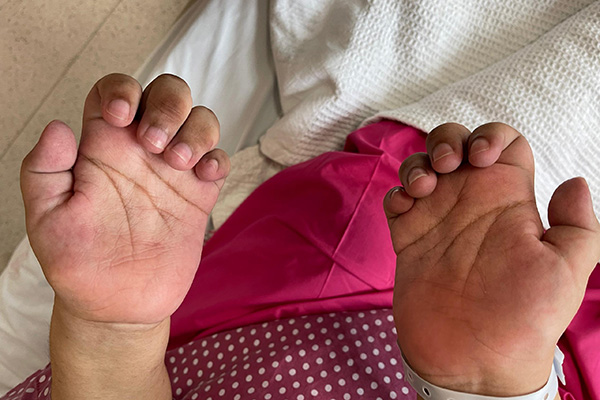
Charcot-Marie-Tooth (CMT) disease is a hereditary peripheral neuropathy characterised by slowly progressive, distal-to-proximal muscle weakness. The anaesthetic concerns are the associated respiratory and diaphragmatic muscle weakness, phrenic nerve palsy, and increased sensitivity to anaesthetic agents. Our case report described a patient with underlying CMT disease who had undergone elective Caesarean delivery (CD) under combined spinal-epidural (CSE) anaesthesia. She had underlying bronchial asthma with recent exacerbation secondary to pneumonia at 25 weeks’ gestation. Her lung function test showed a moderately restrictive pattern. We decided to perform CSE using an intrathecal dose of heavy bupivacaine 8.5 mg and fentanyl 15 mcg under pre-procedural ultrasound guidance. The surgery was uneventful, and postoperative analgesia was maintained with an epidural infusion of ropivacaine 0.1% combined with fentanyl 2 mcg/mL running at 5 mL/hour. The patient’s neurological status returned to baseline on postoperative day one. Our case showed the successful use of CSE for elective CD in the patient with CMT disease without worsening neurological symptoms. With a thorough preoperative assessment of neurological status, utilisation of ultrasound guidance and minimum effective local anaesthetic dosage, neuraxial anaesthesia can be safely performed in patients with CMT disease.
References
Divakara K. Charcot-Marie-Tooth disease [Internet]. [place unknown]: Medscape; [updated 2023 February 6; cited 2025 Aug 4]. Available from: https://emedicine.medscape.com/article/ 1232386-overview
Zanjani AP, Ghorbani A, Eslami B, Mirzashahi B. Epidural Anesthesia Combined with Light General Anesthesia for a Juvenile with Charcot-Marie-Tooth Disease Undergoing Corrective Spine Surgery: A Case Report. Anesth Pain Med. 2017;7:e14189. https://doi.org/10.5812/aapm.14189
Brock M, Guinn C, Jones M. Anesthetic management of an obstetric patient with Charcot-Marie-Tooth disease: a case study. AANA J. 2009; 77: 335-337.
Rodríguez-Ortiz E, Martínez E, Martín J, Maiza L, Medina J. Spinal anesthesia in a patient with Charcot-Marie-Tooth disease undergoing orthopedic surgery: case report. Colomb J Anesthesiol. 2019;47:180-183. https://doi.org/10.1097/CJ9.0000000000000115
New York School of Regional Anesthesia [Internet]. Spinal sonography and application of ultrasound for central neuraxial blocks; cited [ 2026 Apr 9]. Available from https://www.nysora.com/ techniques/neuraxial-and-perineuraxial-techniques/spinal-sonography-and-applications-of-ultrasound- for-central-neuraxial-blocks/
McClain RL, Rubin DI, Bais KS, Navarro AM, Robards CB, Porter SB. Regional anesthesia in patients with Charcot-Marie-Tooth disease: a historical cohort study of 53 patients. Anesthésie régionale chez les patients atteints de la maladie de Charcot-Marie-Tooth : une étude de cohorte historique de 53 patients. Can J Anaesth. 2022;69:880-884. https://doi.org/10.1007/s12630-022-02258-5
Roriz D, Goncalves D, Brandao J, et al. Charcot-Marie-Tooth And Analgesia for Labor- Case Report. Reg Anesth & Pain Med. 2019; 44(Suppl 1)A143. https://doi.org/10.1136/rapm-2019-ESRAABS2019.203
Skorupinska M, Ramdharry G, Byrne B, Laurá M, Reilly MM. Pregnancy and delivery in patients with Charcot-Marie-Tooth disease and related disorders. Obstet Med. 2023;16:83-87. https://doi.org/10.1177/1753495X221107328
Eiko O, Mamoru M, Keiji H, Miho K. Optimal intrathecal hyperbaric bupivacaine dose with opioids for cesarean delivery: a prospective double-blinded randomized trial. IJOA. 2017;31:P68-73. https://doi.org/10.1016/j.ijoa.2017.04.001
Vinci P, Lapi G. Anesthetic management in Charcot-Marie-Tooth disease type 2 due to a mutation in the mitofusin-2 gene. J Anaesthesiol Clin Pharmacol. 2011;27:286-287. https://doi.org/10.4103/0970-9185.81845

This work is licensed under a Creative Commons Attribution-NonCommercial-ShareAlike 4.0 International License.
Copyright (c) 2026 Lau Chin, Mohd Rohisham Zainal Abidin